The ideal cadence on an indoor trainer: how fast should you pedal?
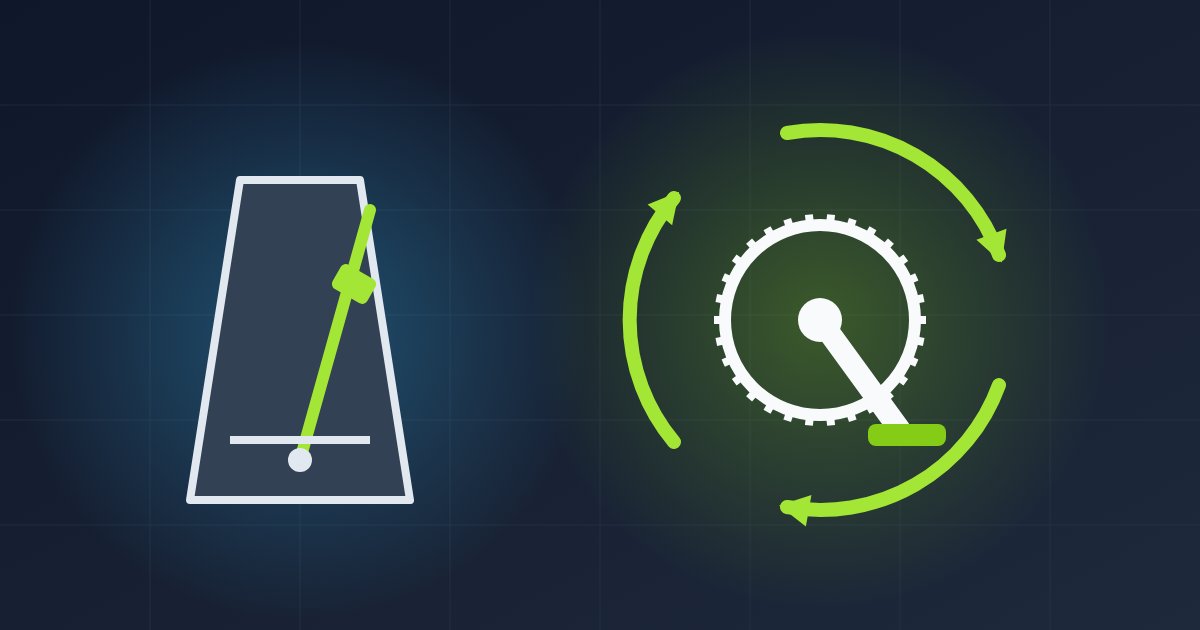
Pretty much everyone who gets on an indoor trainer for the first time ends up asking the same question: how many pedal strokes per minute should I be doing? Some riders spin like a kitchen mixer, others grind a huge gear like they're climbing an Alpine pass. So is there a magic number?
Spoiler: there's no perfect cadence that fits everyone. But there is a comfortable range that works for most people, some clear signs you're outside it, and a simple way to train so you pedal more efficiently. That's what we'll cover here.
What cadence is (and why it matters)
Cadence is the number of full pedal revolutions you make in one minute, measured in rpm (revolutions per minute). If you count 22 turns of your right foot in 15 seconds, you're at roughly 88 rpm.
Put simply, the power you produce comes from two things: how hard you push on the pedal and how fast it turns. That means you can hit the same power in two different ways:
- big gear, low cadence: lots of force on every stroke, more load on your muscles and knees;
- easy gear, high cadence: less force per stroke, more work for your heart and lungs.
Neither one is wrong. The point is that each style tires you out differently. Muscular fatigue tends to build up and stick around during a long session, while your cardiovascular system can handle a steady effort quite well as long as you don't overdo it. That's why so many riders end up happier with a slightly faster spin.
The range that works for most riders
Ask any coach and you'll probably hear something like "between 80 and 100 rpm on the flat." It isn't a rule, just a starting point that tends to work well for people who ride regularly.
If you're new to this, 75 to 90 rpm is usually more realistic. Early on, spinning very fast can make you bounce on the saddle and leave you breathing hard without actually pushing much power. With time and practice, a higher cadence starts to feel natural.
A few practical reference points:
- Below 70 rpm for long stretches: probably too big a gear for the intensity. Your knees and quads usually complain first.
- 80 to 95 rpm: the comfort zone for a lot of riders during steady sessions.
- Above 100 rpm: great for sprints and technique drills, but hard to hold smoothly if you haven't practised it.
Also keep in mind that your "natural" cadence is personal. Leg length, background in other sports and even crank length all play a part. If you feel good at 85 and the strongest rider in your group spins at 95, that's perfectly fine.
How to tell if your cadence is off
Rather than chasing a number, pay attention to what your body is telling you:
- Hips rocking on the saddle: you're spinning faster than your technique allows right now. Ease off a little or shift to a slightly harder gear.
- Knee pain after riding: could be a gear that's too heavy (or your bike fit, but that's a topic for another post). If the pain keeps coming back, see a professional.
- Legs burning early while your breathing is calm: you're asking too much of your muscles. Shift to an easier gear and spin faster.
- Breathing hard but legs feel fresh: the opposite. You can probably shift up a bit and slow your cadence down.
On a trainer all of this gets even more obvious, because there are no descents to recover on and no traffic lights to stop at. Whatever cadence you pick, you're stuck with it, stroke after stroke.
Drills to improve your pedalling
Cadence is trainable. You don't need anything fancy, just a cadence readout (most sensors and smart trainers show one) or, at worst, a stopwatch and the patience to count.
Cadence ladder (10 minutes): after warming up, ride 2 minutes at 80 rpm, 2 at 90, 2 at 100, then settle at 85 for 4 minutes. Keep the gear light; the goal is smooth, round pedalling without bouncing.
Single-leg drill (trainer only, carefully): if your setup allows it, unclip one foot for 30 seconds and pedal with the other leg in an easy gear. It quickly shows you where the dead spot in your stroke is. Do 3 reps per side. If anything feels uncomfortable, skip this one.
High-cadence blocks: 6 reps of 1 minute at 100 to 110 rpm at an easy effort, alternating with 1 minute at your natural cadence. Over time, spinning fast stops feeling clumsy.
Low-cadence strength work: the opposite has its place too. 4 blocks of 3 minutes at 60 to 70 rpm in a big gear, at moderate intensity, help simulate climbing. Use common sense: if your knees complain, stop.
Do one or two of these drills a week, mixed into your regular rides. There's no need to turn every session into a technique class.
Putting it all together
Here's a simple rule of thumb: on long, easy rides, keep your cadence wherever feels comfortable, usually between 80 and 95. During hard intervals, it's normal for it to creep up a bit. On simulated climbs it'll naturally drop, and that's fine.
The key thing is to know your number. Plenty of beginners spend months riding at 65 rpm without noticing, then wonder why their legs are cooked halfway through a session. Just glancing at your cadence every now and then is enough to start improving.
With Peba Pro you can follow your workout and experiment with these ranges at your own pace: a little today, a little better next week. Nobody goes from rookie to beast in one session, but every strong rider started by counting their own pedal strokes.
Jump on your trainer with Peba Pro and start paying attention to your cadence today.
Create Free Account